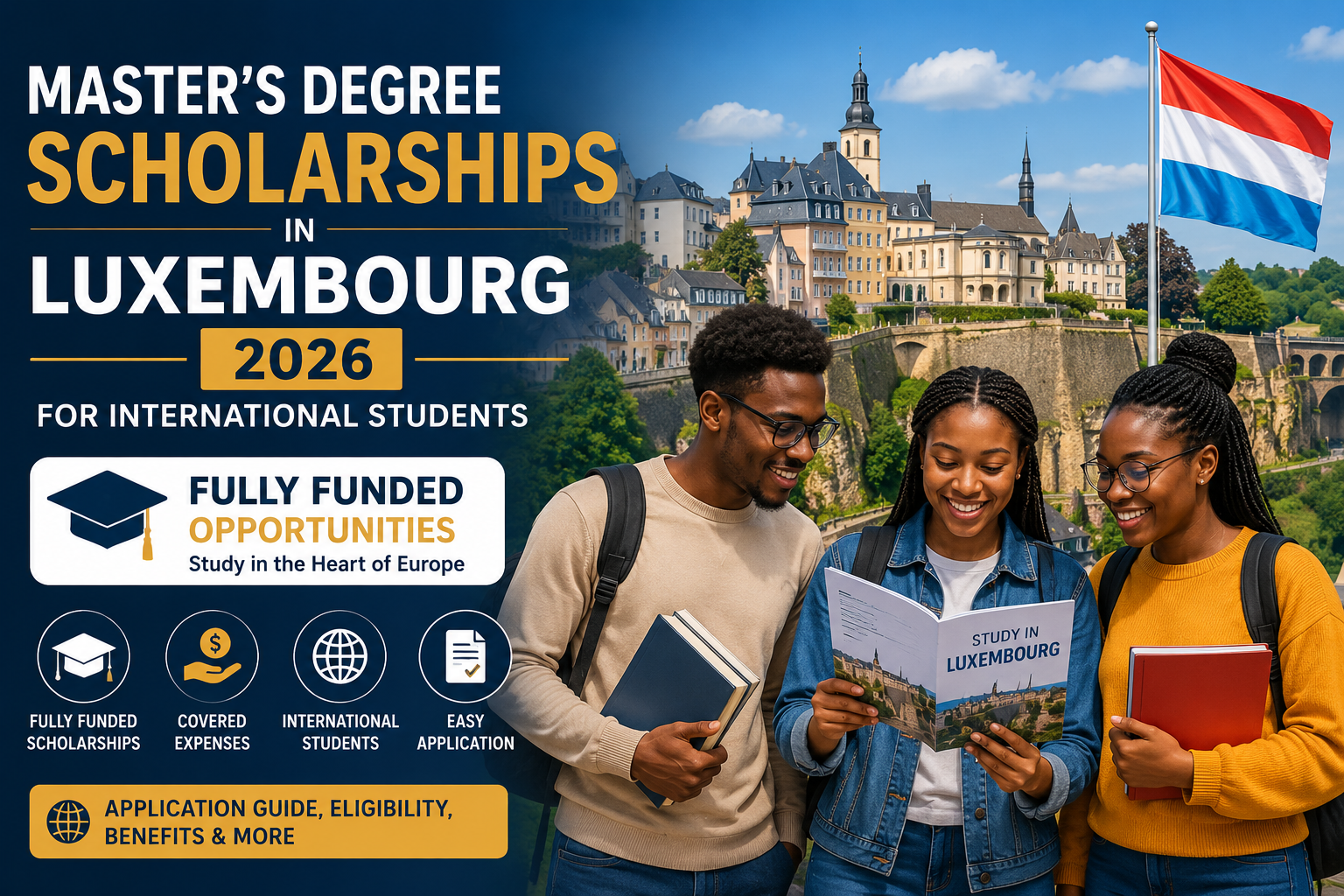
Discover Master’s Degree Scholarships in Luxembourg 2026 for international students. Explore fully funded opportunities, eligibility, and how to apply successfully.
Introduction
What if you could earn a world-class Master’s degree in the heart of Europe — fully funded — in a country that also happens to have the highest GDP per capita in the EU? That’s not a hypothetical. It’s exactly what Master’s Degree Scholarships in Luxembourg 2026 for international students are making possible right now.
Luxembourg may be small, but its academic reputation and scholarship offerings are anything but. The University of Luxembourg is a multilingual, research-intensive institution ranked among Europe’s most internationalized universities, with over 50% of its students coming from outside the country. And thanks to both government-backed and university-administered funding schemes, international students from across the globe have genuine access to fully funded Master’s degree opportunities in Luxembourg.
This guide covers every major scholarship available in 2026, eligibility requirements, what each award covers, application deadlines, and step-by-step advice on putting together a winning application.
Why Study for a Master’s Degree in Luxembourg in 2026?
Before diving into the scholarships, it’s worth understanding why Luxembourg stands out as a study destination — because context matters when you’re choosing where to invest years of your life.
A Truly Multilingual Academic Environment
The University of Luxembourg operates in three official languages — English, French, and German — making it uniquely accessible to international students. Most Master’s programs in finance, computer science, law, and engineering are taught entirely or primarily in English.
Strong Industry Connections
Luxembourg’s economy is built on finance, technology, space, and logistics. Studying there means you’re studying inside the industry, not just reading about it. Students regularly land internships at institutions like the European Investment Bank, Clearstream, SES, and Amazon Europe — all headquartered in or near Luxembourg City.
Research Excellence
The university is consistently ranked in the top 250 globally by Times Higher Education and hosts major research centers including the Luxembourg Centre for Systems Biomedicine (LCSB) and the Interdisciplinary Centre for Security, Reliability and Trust (SnT). For research-focused Master’s students, these are world-class environments.
Now, let’s get into the scholarships themselves.
Major Master’s Degree Scholarships in Luxembourg 2026
1. Luxembourg Government Scholarships for International Students (BOURSE.LU)
This is the most prominent Luxembourg government scholarship for international students and the one you’ve likely already heard about.
Administered by the Ministry of Higher Education and Research, the Luxembourg State Scholarships (officially distributed through the bourse.lu portal) are available to both resident and non-resident international students pursuing higher education in Luxembourg.
What it covers:
- A monthly allowance to help cover living costs
- Potential contribution toward tuition fees (depending on residency status and program type)
- Renewable annually based on academic progress
Eligibility highlights:
- Must be enrolled in or admitted to an accredited program at the University of Luxembourg
- Non-resident students (those who have not lived in Luxembourg) have more limited access to certain state grants, but specific international scholarship tracks exist
- Academic merit and financial need are both considered
How to apply: Applications are submitted through the official bourse.lu government portal. The application window typically opens in spring for the following academic year. You’ll need proof of admission, academic transcripts, passport, and supporting financial documents.
Key tip: Secure your university admission letter first. You cannot complete the state scholarship application without it.
2. University of Luxembourg Excellence Scholarships
The University of Luxembourg offers its own internal excellence-based scholarships for Master’s students, separate from state funding. These are competitive awards targeting high-achieving international applicants.
What it covers:
- Full or partial tuition waiver
- Monthly stipend ranging from €800 to €1,500 depending on the program and funding track
- Some awards include research assistant positions with additional compensation
Eligibility highlights:
- Open to international students from all countries
- Strong academic record required (typically a GPA equivalent to distinction or first-class honors)
- Priority given to applicants in STEM, finance, law, and computer science programs
- English proficiency proof required (IELTS 6.5+ or equivalent)
Applicable Master’s programs include:
- Master in Finance (taught in English, closely tied to Luxembourg’s financial sector)
- Master in Computer Science
- Master in European Law
- Master in Integrated Systems Biology
Application process: Applied for during or after the university’s main admissions process. Check the University of Luxembourg’s official scholarship page (uni.lu) for program-specific deadlines, as they vary by department.
3. FNR (Luxembourg National Research Fund) Master’s Funding
The Fonds National de la Recherche (FNR) is Luxembourg’s national research funding body, and it offers financial support to Master’s students engaged in research-oriented programs.
This isn’t a traditional scholarship in the sense of a lump-sum award — instead, FNR funding often comes through research project grants where Master’s students are hired as research associates within funded projects, receiving a salary or stipend while completing their degree.
What it covers:
- Monthly research stipend (typically €1,400–€2,000/month for Master’s-level researchers)
- Full integration into active research teams
- Conference travel support in some cases
How to access FNR funding: Rather than applying directly, students typically access this funding by contacting professors leading FNR-funded projects and expressing interest in joining their teams. The FNR project database is searchable at fnr.lu.
Why this matters: FNR-linked positions are highly competitive but offer some of the best-funded Master’s experiences in Luxembourg, combining academic training with real research output.
4. Guillaume Dupaix International Scholarship (and Similar Named Awards)
Named scholarships like the Guillaume Dupaix International Scholarship and other commemorative awards are periodically offered through the University of Luxembourg and affiliated foundations. These are typically smaller in number but can be highly targeted toward specific fields or nationalities.
General characteristics of named scholarships:
- Vary in value (from €2,000 one-time awards to full annual stipends)
- Often tied to specific academic departments or research centers
- May prioritize students from developing countries or underrepresented regions
- Application requirements vary but usually include a motivation letter, recommendation letters, and an academic portfolio
How to find them: The best approach is to directly contact the University of Luxembourg’s Financial Aid Office and check the dedicated scholarships database on the university website. Named scholarships are sometimes not widely advertised, and direct inquiry often yields results that a Google search won’t.
5. Erasmus+ Scholarships for Master’s Programs in Luxembourg
If you’re coming from within the EU or from a partner country, Erasmus+ funding can cover your Master’s studies in Luxembourg significantly.
The Erasmus Mundus Joint Master Degrees (EMJMD) program is particularly relevant — these are fully funded scholarships covering tuition, travel, and a monthly living allowance for international students enrolled in joint European Master’s programs that include Luxembourg as one of the partner institutions.
What Erasmus+ Master’s funding covers:
- Full tuition waiver (up to €9,000/year for EU students; up to €18,000/year for non-EU students in some programs)
- Monthly living allowance of €1,000–€1,400
- Travel and installation allowances
Eligibility: Open to students worldwide for EMJMD programs. Competition is high, but the financial package is among the most generous available to international Master’s students anywhere in Europe.
Where to search: The official EACEA (European Education and Culture Executive Agency) scholarship database lists all active Erasmus Mundus programs at eacea.ec.europa.eu.
Financial Aid for International Students in Luxembourg: A Quick Comparison
| Scholarship | Monthly Value | Covers Tuition? | Open to Non-EU? | Deadline |
|---|---|---|---|---|
| Luxembourg State Scholarship | €400–€800+ | Partial | Limited | Spring (bourse.lu) |
| UL Excellence Scholarship | €800–€1,500 | Full/Partial | Yes | Program-specific |
| FNR Research Stipend | €1,400–€2,000 | Yes (via position) | Yes | Rolling (project-based) |
| Named Awards (e.g., Dupaix) | Varies | Varies | Yes | Check annually |
| Erasmus Mundus EMJMD | €1,000–€1,400 | Full | Yes | Jan–Feb typically |
Eligibility Requirements: What You Generally Need
While each scholarship has its own specific criteria, most Master’s degree funding in Luxembourg programs look for the following:
Academic requirements:
- A completed Bachelor’s degree (or equivalent) with strong grades — typically upper second class or equivalent
- Relevant field of study aligned with the Master’s program
- Academic references from professors or supervisors
Language requirements:
- English proficiency: IELTS 6.5–7.0 or TOEFL iBT 90+ for English-taught programs
- French B2 or German B2 may be required for programs in those languages
- Some programs accept applicants with no French requirement if the program is English-taught
Documentation typically required:
- Certified copies of academic transcripts and Bachelor’s degree certificate
- Valid passport
- CV/resume (European format preferred)
- Personal statement or motivation letter (usually 500–800 words)
- Two or three academic/professional recommendation letters
- Proof of language proficiency
- For state scholarships: proof of financial situation
How to Write a Winning Scholarship Application for Luxembourg
Getting the documents together is only half the battle. Here’s what separates successful applicants from the rest:
1. Tailor Your Motivation Letter Specifically
Generic motivation letters fail. A strong letter for a Luxembourg scholarship should:
- Reference specific research centers, professors, or industry connections at the University of Luxembourg
- Explain why Luxembourg — not just “Europe” — is the right environment for your goals
- Connect your past academic and professional experience directly to your intended Master’s program
- Be concise: aim for 500–700 words, not more
2. Get Strong Recommendation Letters Early
Ask recommenders who know your academic work specifically — not just your general character. Give them a briefing note about the scholarship and program so their letter speaks directly to what the selection committee is looking for.
3. Apply for University Admission First
For almost every scholarship in this guide, university admission is a prerequisite or at minimum a parallel process. Don’t wait on the scholarship to apply for admission. Get your admission letter secured first.
4. Apply to Multiple Funding Sources Simultaneously
There’s no rule against holding a University Excellence Scholarship while also receiving an Erasmus+ grant or FNR project support in some cases. Stack your applications strategically.
5. Check Deadlines Carefully by Program
Unlike some countries with a single central scholarship deadline, Luxembourg’s Master’s degree funding opportunities have staggered, program-specific deadlines. Some open in October for the following September intake; others close in February or March.
Life in Luxembourg as an International Master’s Student
Practical context helps when planning a move. Here’s a snapshot:
- Tuition fees: The University of Luxembourg charges approximately €400 per semester for most Master’s programs — one of the lowest in Europe for the quality offered.
- Living costs: Budget roughly €1,200–€1,800/month for accommodation, food, transport, and personal expenses in Luxembourg City.
- Free public transport: Luxembourg made all public transport nationwide free in 2020 — a genuine financial relief for students.
- Student part-time work: International students are permitted to work up to 10 hours per week during term time without a separate work permit if enrolled at the University of Luxembourg.
- Post-study options: Luxembourg’s job market actively absorbs international graduates, particularly in finance, tech, and law. Many international students transition directly to employment after graduation.
Conclusion
Luxembourg offers a rare combination: top-tier academic programs, a deeply international campus culture, and a scholarship ecosystem that genuinely supports international students at the Master’s level. Whether you access Master’s Degree Scholarships in Luxembourg 2026 for international students through the state bourse system, the University’s own excellence awards, FNR research positions, or Erasmus Mundus programs, the funding options are real, accessible, and worth pursuing seriously.
The country is small, but the opportunities it offers to international Master’s students are outsized — in academic quality, industry access, and post-graduation career prospects. Your Master’s degree in Luxembourg could be the most strategic investment you make in your future.
Start today: visit uni.lu and bourse.lu, check your target program’s specific deadlines, and begin drafting your motivation letter. Drop a comment below with your field of study — we’d love to point you toward the most relevant funding opportunity!
Frequently Asked Questions (FAQs)
Q1: Are there fully funded Master’s scholarships in Luxembourg for students from Africa or Asia? Yes. The University of Luxembourg Excellence Scholarships and Erasmus Mundus Joint Master Degree programs are open to students from all countries, including those in Africa, Asia, and Latin America. The Erasmus Mundus awards in particular are specifically designed to attract high-achieving students from outside Europe and offer some of the most generous non-EU funding packages available anywhere in Europe.
Q2: Do I need to speak French to study a Master’s degree in Luxembourg? Not necessarily. Many Master’s programs at the University of Luxembourg are taught entirely in English, including programs in Computer Science, Finance, and Integrated Systems Biology. However, learning basic French will significantly help with daily life outside the classroom, and some programs do require French or German proficiency alongside English.
Q3: When should I start applying for Master’s scholarships in Luxembourg for 2026 intake? Ideally, you should begin preparing your application materials — transcripts, recommendation letters, language certificates, and motivation letter — at least six to nine months before your intended start date. For a September 2026 intake, that means starting no later than November or December 2025. Some Erasmus Mundus program deadlines fall as early as January or February.
Q4: Can I work while studying on a scholarship in Luxembourg? Yes, international students enrolled at the University of Luxembourg are generally permitted to work part-time, up to 10 hours per week during the academic term, without needing a separate work authorization. Some FNR-funded research positions also count toward this limit while simultaneously fulfilling your academic requirements. Always verify your specific visa conditions with the university’s international student office.