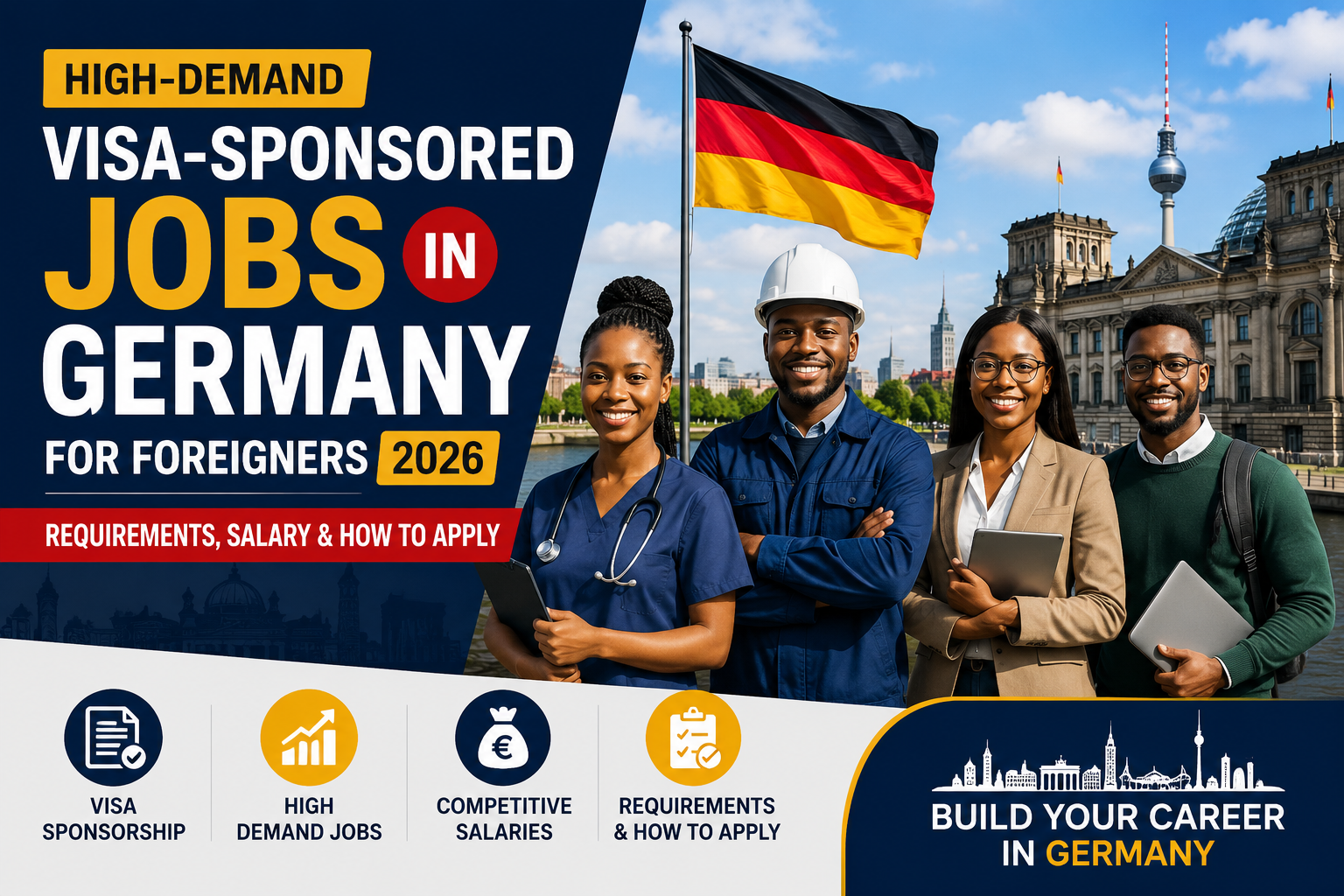
Explore Germany visa sponsorship jobs 2026 — top sectors, salary ranges, requirements, and a step-by-step guide to land your dream job in Germany as a foreigner.
Introduction
What if your next career move took you straight to the heart of Europe — with your visa covered by your employer? For thousands of foreign professionals in 2026, that’s not a fantasy. It’s happening right now in Germany.
Germany is facing one of the most significant labor shortages in its modern history. According to the Federal Employment Agency (Bundesagentur für Arbeit), the country has over 570,000 unfilled positions across critical sectors — and that number continues to climb. To close the gap, German employers are actively offering Germany visa sponsorship jobs in 2026 to qualified candidates from outside the EU.
Whether you’re a nurse, software developer, engineer, or skilled tradesperson, Germany has a structured and transparent pathway to get you working legally and living comfortably in one of Europe’s strongest economies.
In this post, you’ll learn exactly which jobs are in highest demand, what salaries to expect, what requirements you need to meet, and how to apply — step by step.
Why Germany Is Actively Recruiting Foreign Workers in 2026
Germany’s labor crisis isn’t a temporary blip. It’s a structural challenge driven by an aging population and decades of low birth rates. The country’s Skilled Immigration Act (Fachkräfteeinwanderungsgesetz), significantly expanded in 2023 and further refined in 2025, now provides one of the most accessible legal frameworks in Europe for non-EU skilled workers.
Here’s what makes Germany stand out as a destination for Germany employment opportunities for foreigners:
- Strong legal protections for foreign workers — same rights as German employees
- Employer-sponsored visas in multiple sectors
- Recognized credential pathways via the Recognition Advisory Centre (BQ Portal)
- Clear salary minimums enforced by law (minimum wage: €12.82/hour as of 2025)
- Permanent residency pathways after just 21–33 months for skilled workers
Germany isn’t just opening its doors — it’s actively holding them open. So which roles are most in demand?
Top High-Demand Visa-Sponsored Jobs in Germany for Foreigners in 2026
1. Nursing and Healthcare Jobs in Germany with Visa Sponsorship
If there’s one sector where the demand is both urgent and consistent, it’s healthcare. Germany needs tens of thousands of nurses, care workers, and medical assistants — and hospitals, clinics, and care homes across the country are sponsoring visas to fill these roles.
What roles are available?
- Registered Nurses (Gesundheits- und Krankenpfleger)
- Elder Care Workers (Altenpfleger)
- Physiotherapists
- Medical Laboratory Technicians
- Midwives
Salary range: €28,000–€48,000/year (senior nurses and specialists earn more)
Requirements:
- A recognized nursing or healthcare qualification (evaluated via anabin database or KMK)
- Minimum B2 German language proficiency (B1 may be accepted during a transition period)
- Clean criminal background check
- Health certificate
Many German hospitals offer language training support and even cover the cost of credential recognition as part of their sponsorship packages. This is a genuine game-changer for internationally trained nurses.
Nursing jobs in Germany with visa sponsorship are among the fastest to process — some applicants receive visa approval in as little as 4–6 weeks through the accelerated skilled worker pathway.
2. Engineering Jobs in Germany with Visa Sponsorship
Germany’s world-class manufacturing, automotive, and infrastructure sectors run on engineers. Companies like BMW, Siemens, Bosch, and Deutsche Bahn regularly hire foreign engineers through sponsored visa programs.
In-demand engineering specializations:
- Mechanical Engineers
- Electrical Engineers
- Civil and Structural Engineers
- Software Engineers (increasingly categorized here due to product overlap)
- Chemical and Process Engineers
- Renewable Energy Engineers
Salary range: €45,000–€85,000/year (senior engineers at major firms can exceed €100,000)
Requirements:
- A recognized university degree in an engineering field
- Relevant work experience (typically 2–5 years)
- B1–B2 German language skills (some multinationals accept English-only candidates)
- Job offer from a German employer
Engineering jobs in Germany with visa sponsorship are particularly accessible through the EU Blue Card, which requires a minimum annual salary of €43,800 for shortage occupations — a threshold most engineering roles comfortably exceed.
Are you an engineer wondering whether your degree qualifies? The anabin database (run by the German Standing Conference of Ministers) lets you check your qualification’s recognition status before you apply.
3. IT and Technology Jobs in Germany for English Speakers
Germany’s tech sector is booming, and this is arguably the best space for jobs in Germany for English speakers with visa sponsorship. Berlin, Munich, and Hamburg have become major European tech hubs, with hundreds of startups and established companies operating in English-first environments.
Most sought-after IT roles:
- Software Developers (Java, Python, JavaScript, C++)
- Data Scientists and Machine Learning Engineers
- Cybersecurity Analysts
- Cloud Infrastructure Engineers (AWS, Azure, GCP)
- DevOps and Site Reliability Engineers
- UX/UI Designers
Salary range: €50,000–€100,000/year (senior engineers and ML specialists often earn €90,000+)
Requirements:
- Degree in Computer Science, Software Engineering, or related field (or demonstrable equivalent experience)
- Strong portfolio or GitHub profile
- English proficiency (B2); German is a bonus but often not required in tech roles
- Job offer from an eligible employer
Germany’s tech companies — from Zalando and SAP to N26 and HelloFresh — actively sponsor visas for qualified developers. Many post directly on LinkedIn, Glassdoor, and niche boards like Berlin Startup Jobs or StepStone.de.
4. Construction and Trades Jobs with Visa Sponsorship
Germany’s construction industry faces a shortage of over 90,000 workers, according to the German Construction Industry Federation (HDB). Skilled tradespeople — plumbers, electricians, welders, and carpenters — are in enormous demand.
In-demand trade roles:
- Electricians and Electrical Technicians
- Plumbers and Heating Engineers
- Welders and Metal Workers
- Carpenters and Joiners
- Civil Construction Workers
Salary range: €28,000–€52,000/year
Requirements:
- Vocational training certificate (Ausbildung) in a relevant trade
- 2+ years of documented work experience
- German language skills (A2–B1 minimum for most trade roles)
- Job offer or apprenticeship placement
Germany’s Opportunity Card (Chancenkarte), introduced in 2024, allows skilled tradespeople to enter Germany for up to one year to look for a job — without needing a confirmed offer first. This is a major advantage for tradespeople considering Germany as a destination.
5. Education and Teaching Jobs in Germany
International schools and language institutes across Germany regularly recruit English-speaking teachers. German state schools are also facing teacher shortages in STEM subjects, creating openings for qualified educators.
Available roles:
- English Language Teachers (EFL/ESL)
- STEM Subject Teachers (Math, Physics, Chemistry)
- Special Education Teachers
- Early Childhood Educators (Erzieher)
Salary range: €30,000–€55,000/year (state school teachers can earn significantly more with tenure)
Requirements:
- Bachelor’s degree (minimum) in Education or the relevant subject
- Teaching qualification or TEFL/CELTA certificate for language roles
- German language skills vary by role (not always required at international schools)
6. Logistics, Transport, and Warehouse Jobs
Germany is the logistics backbone of Europe. As a major transit and trade hub, the country needs thousands of truck drivers, warehouse operators, and supply chain managers each year.
In-demand roles:
- HGV / Truck Drivers (EU driving license recognized)
- Warehouse Operatives and Team Leaders
- Logistics Coordinators
- Forklift Operators
Salary range: €24,000–€42,000/year
Requirements:
- Relevant license or certification
- Physical fitness certificate for some roles
- Basic German language skills (A2–B1)
Germany Visa Types for Foreign Workers: What You Need to Know
Understanding which visa applies to your situation is crucial. Here’s a quick breakdown:
| Visa Type | Who It’s For | Minimum Salary | Duration |
|---|---|---|---|
| Skilled Worker Visa | Qualified professionals with job offer | No minimum (market rate) | Up to 4 years |
| EU Blue Card | University-degree holders | €43,800/year (shortage roles) | Up to 4 years |
| Opportunity Card (Chancenkarte) | Job seekers without an offer | Points-based eligibility | Up to 1 year |
| Vocational Training Visa | Those pursuing German Ausbildung | Training allowance | Duration of training |
| Freelance/Self-Employment Visa | Independent contractors | Proof of contracts/income | 1–3 years |
The Skilled Worker Visa is the most common route for employer-sponsored positions. Your employer handles much of the paperwork, and you apply at the German consulate or embassy in your home country.
Step-by-Step: How to Apply for Visa-Sponsored Jobs in Germany
Ready to take action? Here’s how the process works in practice:
Step 1: Get Your Qualifications Recognized
Use the anabin database or contact the Central Office for Foreign Education (ZAB) to determine if your degree or vocational certificate is recognized in Germany. This step is non-negotiable for most visa categories.
Step 2: Learn German (At Least the Basics)
Most visa categories require B1 or B2 proficiency. Start with Goethe-Institut courses or apps like Duolingo and Babbel to build your foundation. For IT roles at international companies, strong English is often enough.
Step 3: Build a Germany-Ready CV
German employers prefer a specific CV format — often called a Lebenslauf — which includes a professional photo, date of birth, and a clean chronological layout. Avoid the North American-style one-pager; two pages are standard here.
Step 4: Search on the Right Platforms
- StepStone.de — Germany’s largest job board
- LinkedIn (filter by “visa sponsorship” or “Fachkräfte”)
- Make it in Germany (official government portal: make-it-in-germany.com)
- Indeed.de
- Berlin Startup Jobs (for tech roles)
- Jobware.de (engineering-focused)
Step 5: Apply and Wait for a Job Offer
Once you receive a written job offer, your employer begins the visa sponsorship process. In many cases, they’ll submit documents to the local Foreigners’ Authority (Ausländerbehörde) on your behalf.
Step 6: Apply at the German Embassy in Your Country
With your job offer, recognized qualifications, and supporting documents, apply for your visa at the nearest German embassy or consulate. Processing times range from 2 weeks to 3 months depending on your country.
Step 7: Arrive, Register, and Start Working
Once in Germany, you must register your address (Anmeldung) within two weeks at the local registration office (Einwohnermeldeamt). Your employer will then complete final work authorization steps.
What Are the Real Benefits of Working in Germany as a Foreigner?
Beyond just having a job, Germany offers a quality of life that’s hard to match:
- Universal healthcare — enrolled through your employer’s contributions
- 30 days annual leave minimum by law
- Strong worker protections — difficult to be dismissed unfairly
- Free or subsidized public transport in many cities
- Path to permanent residency in as little as 21 months (for fast-track skilled workers)
- Family reunification — your spouse and children can join you
Germany isn’t just a career move. For many, it becomes a long-term home.
Conclusion
Germany’s labor shortage is your opportunity. With over half a million unfilled positions and one of the most foreigner-friendly skilled worker visa systems in Europe, Germany visa sponsorship jobs in 2026 are more accessible than ever before.
From nursing and engineering to IT and construction, there’s a path for skilled professionals across almost every sector. The process takes effort — getting your qualifications recognized, learning some German, and building the right CV — but the rewards are substantial: strong salaries, world-class healthcare, job security, and a clear route to permanent residency.
Start today: check the anabin database for your qualification, update your Lebenslauf, and apply on StepStone or Make it in Germany. Your new career in Europe could be closer than you think. Drop your questions or target job in the comments — we’re happy to help you find the right path.
Frequently Asked Questions (FAQ)
Q1: Can I get a job in Germany without speaking German?
Yes — particularly in IT and tech roles at international companies, English is often the working language. However, for nursing, construction, education, and most public-sector roles, German proficiency of at least B1 is required. Investing in German language learning significantly widens your job options.
Q2: How long does Germany visa sponsorship take to process?
Processing times vary. If your qualifications are already recognized and your employer submits documents promptly, the visa can be issued in as little as 4–8 weeks. More complex cases — particularly those requiring credential evaluation — can take 3–6 months. The German government introduced a fast-track procedure (§81a AufenthG) that can reduce employer-side processing to just two weeks.
Q3: Do German employers pay for visa sponsorship?
In most cases, yes. Reputable German employers cover the cost of credential recognition assessments, legal consultations, and employer-side administrative fees. You are typically responsible for your own visa application fee (around €75) and travel to the embassy. Be cautious of any employer asking you to pay large upfront sponsorship fees — this is a red flag.
Q4: What is the minimum salary for a Germany Skilled Worker Visa in 2026?
There is no universal minimum salary for the standard Skilled Worker Visa — you simply need to earn the market rate for your role. However, for the EU Blue Card, the minimum annual gross salary is €43,800 for shortage occupations and €55,200 for all other roles in 2026. Salaries must be confirmed in your employment contract before visa approval.