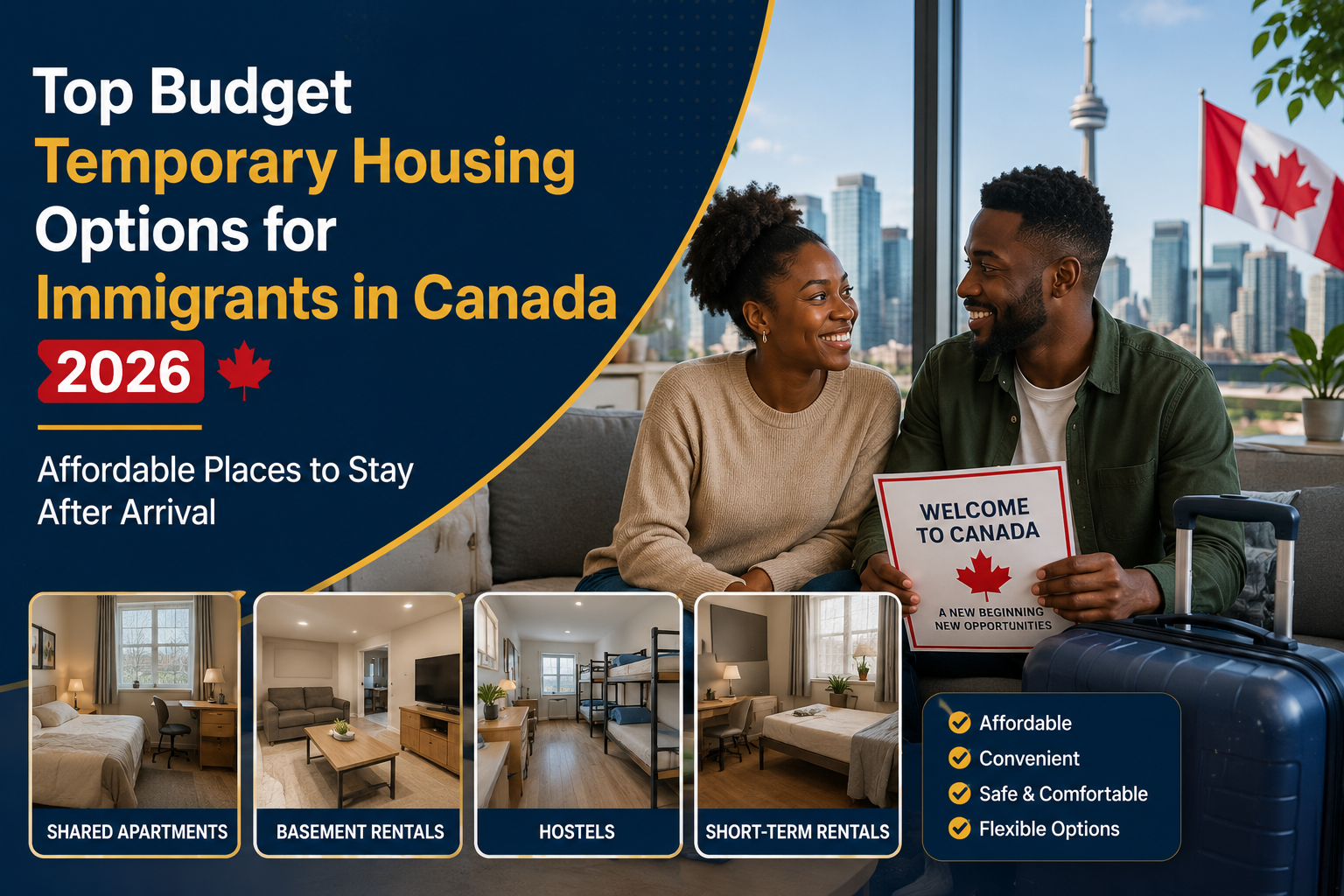
Discover the best budget temporary housing options for immigrants in Canada 2026 — from hostels to government programs — with costs, tips, and city-by-city guidance.
Introduction: Where Do You Sleep on Your First Night in Canada?
It’s a question every newcomer faces — sometimes just hours before landing. Canada welcomes over 400,000 immigrants every year, and for most of them, finding safe, affordable, and flexible temporary housing is the single most stressful task in the first days after arrival.
The challenge is real. Most newcomers don’t have a Canadian credit history. They haven’t secured a job yet. They need somewhere flexible — a place that won’t demand a 12-month lease when they’re still figuring out which neighborhood fits them best. Fortunately, budget temporary housing options for immigrants in Canada are more varied and accessible in 2026 than ever before.
In this guide, you’ll find:
Every major type of affordable temporary accommodation available to newcomers
Real cost ranges for shared rooms, hostels, short-term rentals, and more
Government-supported and settlement agency housing programs — city by city
Specific options for Montreal, Ottawa, Toronto, Vancouver, and budget-friendly alternatives
A practical checklist for securing your housing before you land
Let’s make sure your first nights in Canada are safe, comfortable, and affordable.
Why Temporary Housing Matters More Than You Think
Many new arrivals underestimate how long it takes to secure permanent housing in Canada. The reality is that renting a long-term apartment as a newcomer is genuinely difficult — and it’s not your fault.
Most Canadian landlords require:
A Canadian credit history (which you don’t have yet)
Pay stubs or proof of Canadian employment (which you may not have yet)
A guarantor with a Canadian address
First and last month’s rent upfront — often CAD $2,800 to $5,600 in Toronto or Vancouver
These barriers mean most immigrants spend two to eight weeks in temporary accommodation before transitioning to a permanent rental. Some spend longer. Planning for this period is not just practical — it can prevent financial and emotional stress during one of the most demanding transitions of your life.
According to national housing surveys from Statistics Canada, rent can consume 35–50% of a newcomer’s monthly income. Choosing the right temporary option at the right price protects your savings while you establish yourself.
Option 1: Hostels — The Most Affordable Short-Term Choice
If you’re arriving alone and on a tight budget, hostels are the cheapest option for budget accommodation in Canada for international arrivals, offering flexibility, social connection, and no credit check requirements.
What Hostels Offer Newcomers
Shared dormitory beds: CAD $25–$50/night in most major cities
Private rooms: CAD $70–$120/night depending on city and season
No credit check — payment by international debit or credit card is standard
Common spaces: kitchen access, laundry, Wi-Fi, and often communal areas where you can meet other travelers and newcomers
Short stays: book by the night, week, or month — no lease commitment
Hostelworld is the most widely used platform for finding and comparing hostel options across Canada. Local chains like Sandman Inn and Best Western also often provide weekly rates that reduce the nightly cost by 20–30% compared to standard hotel rates, according to VisaVio immigration advisors.
Hostel Costs by City
City
Dormitory (per night)
Private Room (per night)
Notes
Toronto
$30–$55
$80–$140
Higher in downtown; cheaper in North York
Vancouver
$35–$60
$90–$150
Burnaby and Surrey offer better value
Montreal
$25–$45
$70–$110
Cheapest major city for hostel stays
Ottawa
$30–$50
$75–$120
More limited hostel supply
Calgary
$25–$45
$65–$100
Good budget options city-wide
Winnipeg
$20–$35
$55–$85
Most affordable major city overall
Important Tip
Hostels are better suited to individuals arriving alone than to families. If you’re arriving with a partner, children, or relatives, shared accommodation or furnished short-term apartments will be more practical and private.
Option 2: Short-Term Furnished Rentals — The Most Flexible Option
For most newcomers — especially those arriving with family or planning to stay for a month or more — short-term furnished rentals offer the best overall balance of cost, comfort, and flexibility. This is the dominant budget-friendly housing solution for newcomers to Canada in 2026.
What Short-Term Furnished Rentals Include
Move-in-ready accommodation: furniture, bed linens, kitchen equipment, and often Wi-Fi and utilities included
Flexible lease terms: typically 1–6 months, with no long-term commitment
No Canadian credit history required — most landlords accept passport, visa documentation, and proof of funds
Options for shared (with other tenants) or private (entire unit)
Cost Ranges Across Canada in 2026
Shared rooms (with other tenants): from CAD $650/month in affordable cities like Winnipeg and Regina
Private furnished apartments:CAD $900–$1,800/month depending on city, size, and included utilities
Montreal: typically CAD $700–$1,200/month — the most affordable major city for this type of accommodation
Toronto and Vancouver: CAD $1,200–$2,000/month for private furnished units; suburbs like Burnaby (Vancouver area) and North York (Toronto area) offer $900–$1,500/month options
Where to Find Short-Term Furnished Rentals
Kijiji.ca — Canada’s largest classifieds platform; filter for “short-term” + “furnished” in your target city; this is the most widely used platform by immigrant-friendly landlords
Facebook Groups — Search “Toronto Immigrants Housing,” “Newcomers to Canada Housing,” or “[City Name] Newcomer Housing” for community-specific listings and flexible landlords who understand newcomers’ needs
Airbnb Monthly Stays — Airbnb offers discounted rates for bookings of 28+ nights; a furnished one-bedroom in downtown Toronto averaging $150–$200/night can drop to around $120/night equivalent on a monthly basis
Rentals.ca and PadMapper — Both platforms have immigrant-friendly filters and verified listings
Craigslist Canada — Especially useful in Vancouver and Toronto; exercise more caution and verify listings carefully
Pro Tip: Book 4–6 Weeks Before Arrival
Immigration advisors recommend beginning your housing search 4–6 weeks before your arrival date. Contact landlords directly, state clearly that you are a newcomer, and prepare a document pack including your passport, visa, proof of savings, and any reference letters from overseas employers. Being upfront builds trust with flexible landlords who regularly work with newcomers.
One important 2026 warning: If you are arriving in Toronto or Vancouver during July–August 2026, be aware that the FIFA World Cup is creating a significant surge in short-term accommodation demand. Early data suggests hotel and Airbnb rates in downtown Toronto and Vancouver could spike by 200–300% during match weeks. If you’re arriving mid-summer, target suburbs like North York (Toronto) or Burnaby (Vancouver) and book as early as possible, according to PrepareForCanada.com’s World Cup housing guide.
Option 3: Shared Housing and Roommate Arrangements
Shared housing — where you rent a private room within a larger apartment or house shared with other tenants — is one of the most cost-effective and socially enriching forms of short-term rental for newcomers in Canada. Many immigrants report that their first Canadian friendships began with housemates.
Why Shared Housing Works Well for Newcomers
Lower cost: Shared rooms average $650–$1,100/month, significantly below private unit rates
Included utilities: Most shared housing includes internet, hydro (electricity), and heat in the monthly rate
Social support: Housemates can recommend grocery stores, transportation options, local services, and job leads
Flexible terms: Most room rentals in shared houses operate on 1–3 month agreements, giving you time to find permanent housing
Where to Find Roommate Arrangements
SpareRoom.ca — The most comprehensive dedicated roommate-finding platform in Canada, with verified listings across all major cities
Facebook Groups — City-specific newcomer and housing groups are highly active and often list rooms within hours
Kijiji.ca — “Rooms for Rent” listings are abundant and filterable by city and move-in date
University housing boards — Even if you’re not a student, many university housing boards list quality shared rooms from verified landlords near campus areas with excellent transit links
Option 4: Hotels and Extended-Stay Properties
Hotels offer the most immediate, lowest-friction option for your first nights — no booking complexities, no document packs required, and readily available in every Canadian city. The trade-off is cost.
Standard hotel rooms in major Canadian cities range from CAD $100–$200/night in mid-range properties. For stays beyond a week, this becomes expensive quickly. However, some options make extended hotel stays more budget-friendly:
Weekly rates: Hotel chains like Sandman Inn and Best Western frequently offer weekly rates that reduce the effective nightly cost by 20–30%
Extended Stay Canada and Oakwood: Corporate housing companies specializing in 1–3 month stays; these often include utilities, internet, and basic furnishings — amenities that could cost an additional $200–$300/month if arranged separately from a standard short-term rental. VisaVio immigration advisors note that a furnished one-bedroom Airbnb in downtown Toronto at $150–$200/night compares favorably with a monthly corporate rental in the same area averaging approximately $120/night equivalent, with better amenities
Motels: For the most budget-conscious option during a very short-stay transition period, motels in suburban locations offer rates of $60–$90/night with basic amenities
Best Strategy for Hotel Stays
Use hotels or motels for a maximum of one to two weeks while you actively search for furnished short-term rentals or shared housing. They are excellent for the first nights after arrival — when jet lag, paperwork, and orientation tasks absorb your energy — but they are too expensive for extended stays.
Option 5: Government-Supported and Settlement Agency Housing
This is the category most newcomers don’t know enough about — and it can make a significant difference, particularly for refugees, asylum seekers, and low-income new arrivals.
YMCA Residences (Montreal) — Temporary Housing for Asylum Seekers
<cite index=”154″>In 2024, 6,981 asylum seekers, including 840 children, stayed in residences run by the YMCAs of Québec.</cite> The YMCAs of Québec operate temporary housing residences specifically for refugees and asylum seekers who have recently arrived in Canada, working in partnership with PRAIDA (Programme régional d’accueil et d’intégration des demandeurs d’asile).
Important: Access to YMCA residence housing in Montreal is through referral only from designated partner organizations. Eligible individuals are asylum seekers and convention refugees who have arrived in Québec within 10 days. Services include airport welcome, French and English conversation workshops, immigration assistance, job search support, and women’s programming.
If you are an asylum seeker arriving in Montreal, contact PRAIDA or a designated settlement organization immediately upon arrival for a referral to YMCA housing.
YMCA Newcomer Information Centre (Ottawa)
The YMCA Newcomer Information Centre in Ottawa has been serving newcomers since 2001 and operates the YMCA-YWCA National Capital Region short-term and monthly housing facility at the Taggart Family Y location at 180 Argyle Avenue, Ottawa. This is one of the most reliable Ottawa newcomer housing options for those arriving in the capital region.
Beyond housing, the Ottawa YMCA NIC provides free settlement services including employment guidance, language class registration, education information, and healthcare navigation — all critical for a smooth transition.
Settlement Organizations with Housing Assistance
Canada’s settlement service network is extensive. Many organizations provide housing search support, subsidized housing referrals, and emergency accommodation access. Key ones include:
National:
IRCC-funded Settlement Service Providers — Find your nearest provider through the Canada.ca newcomer services directory; they can connect you with local housing support from the moment you arrive
Canada Mortgage and Housing Corporation (CMHC) — Provides information on affordable housing programs, tenant rights, and subsidized housing waitlists
City-Specific:
Ottawa: Ottawa Community Immigrant Services Organization (OCISO), Action Logement (Action Housing), Housing Help Ottawa
Toronto: YMCA Newcomer Information Centre (newcomersincanada.ca), providing free settlement planning since 2001
Nova Scotia: Immigrant Services Association of Nova Scotia (ISANS) — offers housing assistance to newcomers settling in Halifax and surrounding areas
British Columbia: BC Housing administers provincial subsidized housing programs that newcomers can apply to after arrival
Manitoba: Manitoba Housing provides subsidized housing options across the province
Subsidized Housing Waitlists
<cite index=”162″>As a new immigrant or refugee, you can add your name to a waiting list for subsidized housing. People on the list are offered housing, once it becomes available, in the order they appear on the list. You can’t add your name to the waiting list before you arrive in Canada.</cite>
Register for provincial subsidized housing waitlists as soon as possible after arrival — waiting times can be long, but early registration maximizes your position. Ask your local newcomer services provider about programs such as Ontario’s Housing Benefit, BC Housing, and Manitoba Housing.
Budget Housing by City: Where Is the Most Affordable?
Not all Canadian cities are equally expensive. Choosing the right city to land in can save you hundreds of dollars per month in housing costs. Here’s a quick city-by-city guide:
Most Affordable Cities for Temporary Housing
Winnipeg and Saskatoon: Shared room options under $1,000/month; overall the most budget-friendly major cities in Canada
Regina: Strong settlement programs and low housing costs relative to income
Halifax and Moncton (Atlantic Canada): Very affordable compared to Toronto and Vancouver; also benefit from LMIA-exempt immigration pathways (Atlantic Immigration Program) that ease the transition to permanent work
Montreal Temporary Housing for International Immigrants
Montreal is consistently the most affordable major Canadian city for temporary housing. Shared rooms start at CAD $650/month, private furnished apartments run CAD $900–$1,400/month, and hostel options start at around $25/night. For French-speaking immigrants and francophone students especially, Montreal offers strong settlement services, a large international community, and lower overall cost of living than Toronto or Vancouver. Key platform: Kijiji Montréal and Facebook groups specifically for Montreal newcomers.
Ottawa Newcomer Housing Options
Ottawa is a government-focused city with strong public transit and active settlement services. Short-term furnished housing runs CAD $950–$1,500/month for private units in accessible neighborhoods. The YMCA-YWCA offers the most structured short-term housing program in the city. Ottawa Community Immigrant Services Organization (OCISO) provides housing search assistance for all newcomers regardless of immigration status.
Toronto
Canada’s largest city is expensive, but the sheer volume of options means deals exist if you know where to look. Focus on North York, Scarborough, and Etobicoke for budget-conscious options of $1,000–$1,500/month for shared housing, with excellent transit links to downtown. Facebook groups and Kijiji are the most active platforms in the city.
Vancouver and Surrounding Areas
Vancouver has some of Canada’s highest housing costs. Newcomers on a budget should look at Burnaby, Surrey, and New Westminster — all well-connected to downtown Vancouver via SkyTrain, with short-term shared housing from $900–$1,400/month. Avoid downtown Vancouver for your temporary housing search; the price premium is not justified for a short-term stay.
Comparison: Budget Temporary Housing Options at a Glance
Housing Type
Cost Range (CAD/month)
Credit Check Needed?
Best For
Flexibility
Hostel (shared dorm)
$750–$1,500
No
Singles, very short stays
Night-by-night
Hostel (private room)
$2,100–$4,200
No
Couples, short stays
Night-by-night
Short-term furnished rental (shared)
$650–$1,100
No
Individuals, students
1–6 months
Short-term furnished rental (private)
$900–$2,000
No
Families, couples
1–6 months
Extended stay hotel / corporate housing
$2,500–$5,000
No
Immediate arrival, executives
Weekly/monthly
YMCA / Settlement housing
Subsidized / free
No (referral-based)
Asylum seekers, refugees
Variable
Subsidized housing (waitlist)
Income-based
No
Low-income newcomers
Long-term
Friends / family hosting
Free or nominal
No
Those with existing connections
Flexible
Practical Checklist: Securing Housing Before You Arrive
Don’t wait until you land to start your housing search. Here’s what to do before your departure:
4–6 weeks before arrival: Begin searching Kijiji, Facebook newcomer housing groups, and Airbnb for furnished short-term options in your target city
Prepare your document pack: Passport, visa, proof of savings (bank statement), any employment or study confirmation, and a brief introduction letter explaining your situation
Contact multiple landlords: Messaging 5–10 options gives you choices; mention you’re a newcomer and ask specifically about their credit check requirements
Book at least your first week: Secure hostel or Airbnb accommodation for your first 7–14 days even before you find your main temporary accommodation — this eliminates day-one stress
Connect with a settlement organization: Visit canada.ca to find the nearest IRCC-funded settlement service provider and reach out before you arrive — many offer pre-arrival housing guidance
Join local Facebook groups: Toronto Immigrants Housing, Montreal Newcomers, Vancouver Newcomers, Ottawa Newcomer Housing — these communities provide real-time listings, scam warnings, and peer support
Conclusion: Your First Home in Canada Is Within Reach
Finding safe, affordable, and flexible housing as a new immigrant in Canada doesn’t have to be overwhelming. The budget temporary housing options for immigrants in Canada in 2026 are genuinely varied — from hostel dorms at $25/night and shared furnished rooms from $650/month, to government-supported housing through YMCA residences in Montreal and settlement organization programs in Ottawa and beyond.
Here’s your key takeaway:
Start early: Search 4–6 weeks before arrival; competition for quality short-term rentals is real
Use the right platforms: Kijiji, Facebook newcomer groups, SpareRoom.ca, and Airbnb Monthly are your most powerful tools
No credit history? Not a problem: Most short-term and shared housing landlords accept passport and visa documents instead
Know your city: Montreal and Winnipeg are the most affordable; Toronto suburbs and Vancouver’s SkyTrain corridor offer the best value in expensive markets
Tap settlement services: YMCA Ottawa, OCISO, ISANS, YMCA Québec, and IRCC-funded providers can refer you to housing support — for free
Budget wisely: Aim to save CAD $15,000–$25,000 before arrival for a single person, or $25,000–$35,000 for a family, to cover your first few months comfortably
Canada is waiting — and so is your first home here.
Start your housing search today using the platforms and resources in this guide. And share your experience in the comments below — which option worked best for you after arriving in Canada? Your story could save another newcomer a lot of stress and money!
Frequently Asked Questions (FAQ)
1. Do immigrants get free housing in Canada?
No. Canada does not provide free housing specifically for immigrants. However, various support programs and resources help newcomers find affordable accommodation. Government-funded settlement organizations can assist with housing searches and referrals. Subsidized housing programs exist for low-income newcomers — but these require waitlist registration after arrival and have significant wait times. The YMCA in Quebec operates temporary residences for asylum seekers and refugees specifically, accessible through referral from partner organizations like PRAIDA. For most economic immigrants, work permit holders, and international students, temporary accommodation is self-funded through hostels, short-term rentals, or shared housing.
2. Do I need a Canadian credit history to rent temporary housing as a newcomer?
No — not for most temporary and short-term housing options. Hostels, furnished short-term rentals, shared rooms found through Kijiji or Facebook groups, Airbnb monthly stays, and YMCA facilities do not require a Canadian credit history. Immigrant-friendly landlords typically accept your passport, visa documentation, and proof of savings in place of a credit check. Long-term lease agreements (12 months+) are where credit history becomes a barrier — which is precisely why starting with short-term temporary accommodation is the practical approach for most newcomers.
3. What is the cheapest city in Canada for temporary housing as a newcomer?
Winnipeg and Saskatoon are consistently the most affordable Canadian cities for newcomer temporary housing, with shared room options available under $1,000/month. Montreal is the most affordable among Canada’s largest major cities — short-term shared rooms start at approximately $650/month, and the city has a large international community, strong settlement services, and significantly lower living costs than Toronto or Vancouver. Statistics Canada and newcomer cost-of-living guides from CanadaGMC.com confirm that cities like Winnipeg, Halifax, and Regina consistently rank among the most affordable for total newcomer cost of living.
4. How far in advance should I book temporary housing in Canada?
Immigration advisors and settlement organizations recommend beginning your search 4–6 weeks before your arrival date. This gives you enough time to contact multiple landlords, prepare your document pack, exchange messages, sign a short-term agreement, and pay your deposit. For arrivals in Toronto or Vancouver during summer 2026 (particularly July–August when FIFA World Cup matches are scheduled), starting your search even earlier — 8–10 weeks out — is strongly advisable, as temporary accommodation rates in downtown areas may spike by 200–300% during the tournament, according to PrepareForCanada.com’s housing analysis.
5. Are there government-supported housing programs specifically for newcomers in Canada?
Yes, though they vary significantly in scope and eligibility. YMCA Québec operates temporary residences for asylum seekers in Montreal through partnership with the provincial PRAIDA program — accessible via referral only. The YMCA-YWCA National Capital Region offers short-term and monthly housing in Ottawa at its Taggart Family Y facility. Provincial housing programs — including Ontario’s Housing Benefit, BC Housing, and Manitoba Housing — offer subsidized housing to eligible low-income residents, including immigrants. Federal subsidized housing waitlists are administered through CMHC and local housing authorities. Canada.ca provides a directory of IRCC-funded settlement providers who can connect newcomers with local housing support in any province.
6. Is it safe to find housing through Kijiji or Facebook groups in Canada?
Generally yes — these are the most widely used and immigrant-friendly platforms for short-term newcomer housing in Canada. However, scams exist on any classified or social media platform. Key safety rules: never transfer money via e-transfer or wire before physically seeing the property or verifying the landlord’s identity; avoid listings with unusually low prices or landlords who claim to be abroad; use video calls to view properties remotely if you haven’t yet arrived; ask for a signed rental agreement before paying any deposit; and report suspicious listings to the platform. PrepareForCanada.com advises newcomers to review a comprehensive list of rental scam tips before searching on social media or local marketplaces.